
Free Full Text Legally
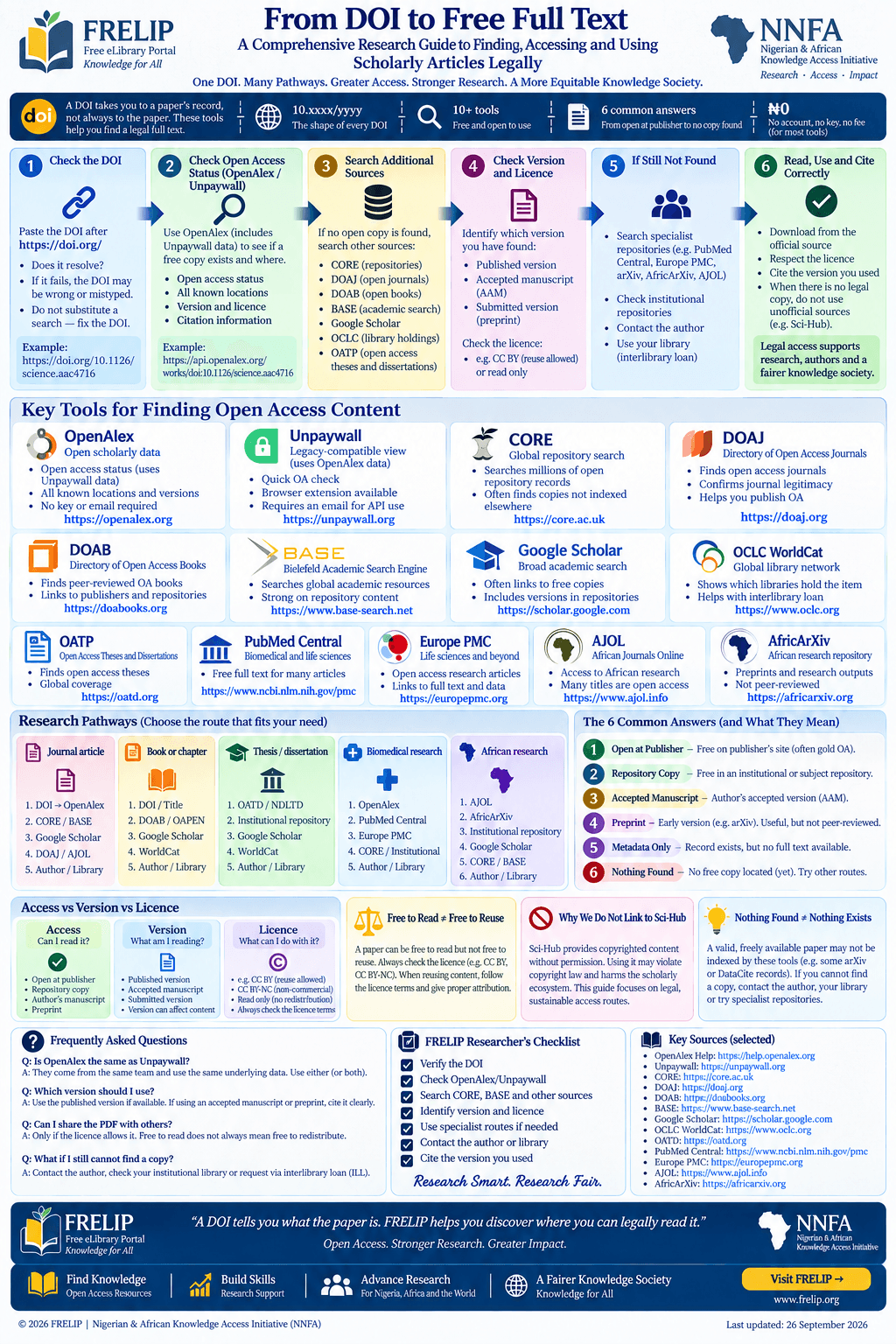
Figure 1, explained — every tool, site and organisation in the diagram
Figure 1 is the whole method on one page, and this section takes it apart: what each step does, what every tool is for, and a link to every service, repository and organisation it names, so you can go to the source rather than take our word for it. The steps it draws are the four checks in this guide, opened out into six.
The six steps in the figure
| Step | What the figure says to do | Go to |
|---|---|---|
| 1. Check the DOI | Paste the DOI after https://doi.org/ and confirm it resolves. If it fails, fix the DOI — do not substitute a search. The figure’s own example is the identifier this guide follows throughout. | doi.org/10.1126/science.aac4716 |
| 2. Check open access status | “Use OpenAlex (includes Unpaywall data)” to see whether a free copy exists and where, then read the open access status, all known locations, the version, the licence and the citation information. | openalex.org · the figure’s API example |
| 3. Search additional sources | When no open copy is found: CORE for repositories, DOAJ for open journals, DOAB for open books, BASE for academic search, Google Scholar for author-posted copies, OCLC WorldCat for library holdings, OATD for theses and dissertations. | the tool table below |
| 4. Check version and licence | Establish whether you are reading the published version, an accepted manuscript (AAM) or a submitted version or preprint — then read the licence, because CC BY permits reuse while “read only” does not. | Creative Commons BY 4.0 |
| 5. If still not found | Try specialist repositories (PubMed Central, Europe PMC, arXiv, AfricArXiv, AJOL), institutional repositories, the author directly, or your library’s interlibrary loan. | the tool table below |
| 6. Read, use and cite correctly | Download from the official source, respect the licence, cite the version you actually used, and when there is no legal copy, do not turn to unofficial sources such as Sci-Hub. | why we do not link to Sci-Hub |
Every tool named in the figure
Thirteen services appear on the figure’s tool cards, plus the resolver in step 1, two more named in the research pathways, and the organisations behind them. Each entry below gives the figure’s own description and the address to go to.
| Tool | What it is, in the figure’s words and ours | Go to |
|---|---|---|
| OpenAlex | “Open scholarly data”: open access status (it now supplies Unpaywall’s data), all known locations and versions, no key or email required. The deepest of the indexes here. | openalex.org · documentation |
| Unpaywall | “Legacy-compatible view (uses OpenAlex data)”: the quick open access check and the browser extension. Its API requires an email address. | unpaywall.org · API documentation |
| CORE | “Global repository search”: millions of open repository records, and the source most likely to hold a copy the main indexes miss. | core.ac.uk · API documentation |
| DOAJ | “Directory of Open Access Journals”: finds open access journals, confirms a journal’s legitimacy, and helps you publish openly. Independent and donation-funded. | doaj.org |
| DOAB | “Directory of Open Access Books”: peer-reviewed open access books, with links to the publishers and repositories that host them. | doabooks.org |
| BASE | “Bielefeld Academic Search Engine”: global academic search, strong on repository content, run by Bielefeld University Library. | base-search.net |
| Google Scholar | “Broad academic search”: often links to free copies, and includes versions held in repositories that the publishers’ own indexes do not surface. | scholar.google.com |
| OCLC WorldCat | “Global library network”: shows which libraries hold an item, which is what makes an interlibrary loan request possible. The catalogue itself is WorldCat; OCLC is the organisation behind it. | search.worldcat.org · oclc.org |
| OATD | “Open Access Theses and Dissertations”: finds open access theses worldwide, with global coverage — the thesis route the figure’s pathways table also points to. | oatd.org |
| PubMed Central | “Biomedical and life sciences”: free full text for many articles, including everything deposited under a funder mandate. | pmc.ncbi.nlm.nih.gov |
| Europe PMC | “Life sciences and beyond”: open access research articles with links to full text and to the underlying data. | europepmc.org |
| AJOL | “African Journals Online”: access to African research, with many titles open access. | ajol.info |
| AfricArXiv | “African research repository”: preprints and research outputs. Preprints are not peer-reviewed, as the figure says. | africarxiv.org |
| OAPEN | Named in the figure’s book-or-chapter pathway alongside DOAB: the open access library for books. | oapen.org |
| NDLTD | Named in the thesis pathway alongside OATD: the Networked Digital Library of Theses and Dissertations. | ndltd.org |
| doi.org | The resolver behind step 1, run by the DOI Foundation — the body that governs the identifier system itself. | doi.org |
The Open Access Button, long listed beside Unpaywall in guides like this one, closed on 18 November 2025. Its own site now redirects readers to Unpaywall, which is why the figure omits it and why some older guides — including one of ours, which we have corrected — still mention it. The retirement notice is still at openaccessbutton.org.
The organisations behind the figure
- FRELIP — the publisher of this guide, and the site the figure’s footer sends readers to: frelip.org.
- NNFA — the Nigerian & African Knowledge Access Initiative, FRELIP’s partner initiative, credited in the figure’s header and footer and the co-author of this guide.
- The DOI Foundation — the body that governs the identifier system used in step 1: doi.org.
- Creative Commons — behind every cc-by and cc-by-nc label in the figure’s licence table: creativecommons.org/licenses.
- Sci-Hub — named in the figure only to be refused. See Why we do not link to Sci-Hub.
The tables and lists in the lower half
The lower half of the figure is working lists rather than a diagram, and each one maps onto a section of this guide:
- Research pathways — five columns (journal article, book or chapter, thesis or dissertation, biomedical research, African research), each a route of five or six sources. This is the figure’s version of the four checks, adapted to what you are looking for.
- The six common answers — open at publisher, repository copy, accepted manuscript, preprint, metadata only, nothing found. The same six verdicts set out in check 4 below.
- Access vs version vs licence — three separate questions: can I read it, what am I reading, what may I do with it. Expanded under version and licence below.
- Free to read ≠ free to reuse, and nothing found ≠ nothing exists — the two boundaries the figure is careful to draw, both treated below.
- FAQ, researcher’s checklist, key sources — the four questions researchers ask most, a six-point checklist, and the list of links the figure was built from.
Below is the box-by-box detail for the elements that need more than a line: the resolver, the indexes, and the repositories and institutions that held copies in the live queries behind this guide.
Box by box: the resolver and the indexes
| Element in the figure | What it is and why it is there | Go to |
|---|---|---|
| doi.org — box 1 | The resolver run by the DOI Foundation, the body that governs the identifier system. Its only job here is to prove the DOI is real and to send you to the record the registrant currently maintains. | doi.org |
| nature.com — our own resolver test, not in the figure | Where our test identifier lands. doi.org/10.1038/nature12373 answered with a redirect straight to the article page, which is what a healthy DOI does. | Nature — Nanometre-scale thermometry in a living cell |
| Unpaywall — box 2 | The lookup most people know: a free index of open copies, with a browser extension and a public API. It answers “is there an open copy, and where?” | unpaywall.org · API documentation |
| OpenAlex — box 2 | The catalogue of scholarly works that now supplies Unpaywall’s data. Useful for the full location list and citation counts — but not an independent check on Unpaywall. | openalex.org · documentation · the announcement that the two run on one codebase |
| CORE — box 3 | A harvester of institutional and subject repositories. It is the source that finds copies the Unpaywall/OpenAlex index does not hold, which is why it is in the chain at all. | core.ac.uk · API documentation |
| Google Scholar — box 3 | Still the highest-recall single search for author-posted copies: the bracketed [PDF] link to the right of a result usually opens a repository copy. | scholar.google.com |
| PubMed Central and Europe PMC — box 3 | The biomedical full-text archives. If a funder required deposit, the article is free here whether or not the publisher page is open. | pmc.ncbi.nlm.nih.gov · europepmc.org |
| arXiv and the prefix rule — box 3 | Some DOIs are registered by preprint servers rather than publishers. A prefix like 10.48550/arXiv.* or 10.1101/* tells you to go straight to the server. | arxiv.org |
The institutions named in the worked examples
The first example, 10.1126/science.aac4716, is the 2015 Science paper on the reproducibility of psychological science. It is paywalled at the publisher and open in repositories — and its location list is the best teaching case in this guide, because the copy the index calls “best” has no PDF at all. These are the institutions our live queries returned, each linked to the repository or university that holds the deposit:
| Institution in the figure | What it holds, per the live data | Go to |
|---|---|---|
| Tilburg University | The best_oa_location: version publishedVersion, licence other-oa — and url_for_pdf is null. A landing page, not a file. | research.tilburguniversity.edu |
| University of Groningen | An acceptedVersion with a PDF — the peer-reviewed text, before the publisher’s typesetting. | rug.nl |
| London School of Economics | Both an acceptedVersion and a submittedVersion, each with a PDF and no licence stated. | researchonline.lse.ac.uk |
| University of Dundee | A submittedVersion with a PDF, licence other-oa. | discovery.dundee.ac.uk |
| Keele University | A submittedVersion with a PDF under cc-by — the most reusable copy in the list. | keele.ac.uk |
| University of Edinburgh | A submittedVersion with a PDF under cc-by. | era.ed.ac.uk |
| Cornell University (second example) | The copy that proves CORE’s value: 10.1108/10650750710776422 is closed on Unpaywall and on OpenAlex, yet CORE holds a PDF deposited through Cornell’s repositories. Cornell’s ILR School collection now lives inside eCommons. | ecommons.cornell.edu · ILR School community |
| Science / AAAS | The publisher record for the hero example: it resolves, it is real, and it is not free. Exactly the situation the chain exists to solve. | science.org |
| WIPO Lex (footer) | The source behind the legal line in the figure: Nigeria’s Copyright Act 2022 (Act No. 8 of 2022), which commenced on 17 March 2023. | Copyright Act 2022 on WIPO Lex |
Two numbers in the figure are worth pausing on. Unpaywall returned 15 locations for the Science paper; OpenAlex returned 47, of which 10 carry a PDF. That gap is not a contradiction — it is the same database presented at different depths, which is the subject of check 3.
The four checks, in order
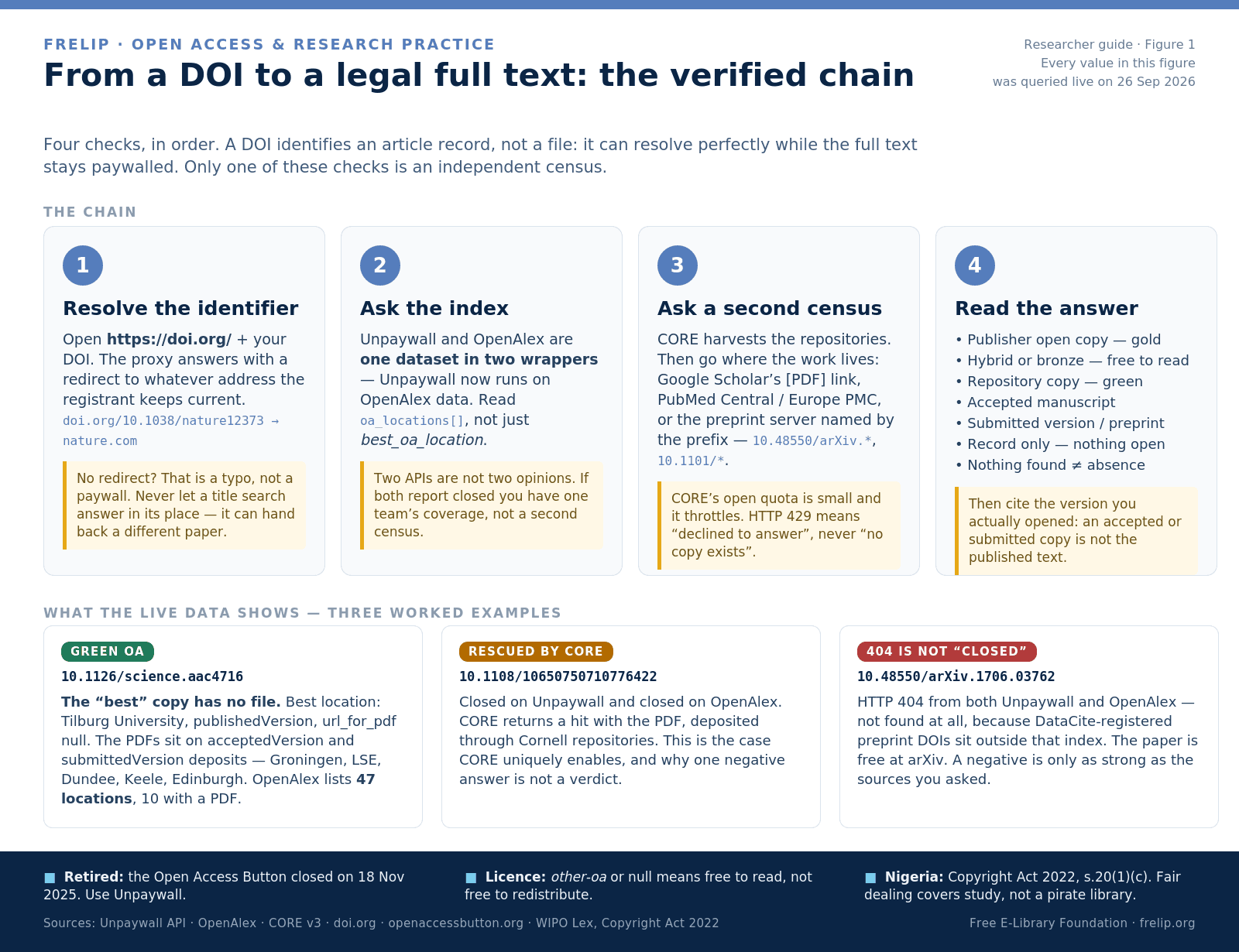
- Resolve the identifier. Confirm the DOI is real before you chase anything.
- Ask the index. Unpaywall, or OpenAlex for the full location list — the same data either way.
- Ask a genuinely different source. CORE, then the place the work actually lives: Scholar, the biomedical archives, or the preprint server named by the prefix.
- Read the answer. Six possible verdicts, each with a different meaning for what you may cite and reuse.
Everything below uses one DOI so you can follow along: 10.1126/science.aac4716, paywalled at the publisher and green in repositories — the most common situation you will meet.
Check 1 — Resolve the identifier
A DOI has two parts: a prefix that begins 10. and a suffix chosen by the registering organisation. Paste the whole thing after https://doi.org/ and the system looks up the current address and forwards you there. We tested it: https://doi.org/10.1038/nature12373 answered with a redirect straight to the Nature article page.
If nothing loads, the identifier is wrong, truncated, or mistyped — and this is where researchers lose time. FRELIP learned the lesson while building its own DOI resolver: a malformed DOI that fell through to a title search came back with a different paper, complete with a confident verdict and a plausible title. A silent wrong answer is worse than an error, because you cite it.
So: fix the DOI, do not substitute a search. A DOI that fails to resolve is a typo, not a paywall.
Check 2 — Ask the index, and know what it is not
Unpaywall is the fastest direct answer to “is this free, and where?”. Paste this into your browser, replacing the DOI and your own email:
https://api.unpaywall.org/v2/10.1126/science.aac4716?email=you@example.org
The email is not optional: Unpaywall requires one as a condition of use, and a request without it returns HTTP 422 with the message “Email address required in API call”. We confirmed both responses. If you would rather not touch an API at all, the free Unpaywall browser extension puts the same answer on the article page you are stuck on.
The part most guides get wrong. Unpaywall and OpenAlex are not two independent databases. They are run by the same team, and Unpaywall now runs on OpenAlex data — the same index delivered through two interfaces. OpenAlex simply shows you more of it: 47 locations where Unpaywall lists 15. So the honest way to use them is:
- Use either one to answer “is there an open copy?”. You do not gain confidence by asking both.
- Use OpenAlex when you need the full location list, versions and citation counts.
- Treat CORE and the subject repositories as the second opinion. That is where an independent answer actually comes from.
And read the fields properly:
is_oa— true or false.oa_status— gold, hybrid, bronze, green or closed.oa_locations[]— walk the whole list, not justbest_oa_location. This is the single most useful line in this guide.
Check 3 — Ask a genuinely different source
Our hero example proves why. Unpaywall labels the “best” location Tilburg University, version publishedVersion — and url_for_pdf is null. Meanwhile the copies that actually contain a PDF are the acceptedVersion and submittedVersion deposits at Groningen, the LSE, Dundee, Keele and Edinburgh. A researcher who stops at best_oa_location concludes there is no file. A researcher who reads the list has six.
Then widen to sources that are not the same database:
- CORE —
https://api.core.ac.uk/v3/search/works/?q=doi:"10.1108/10650750710776422". That identifier is closed on Unpaywall and on OpenAlex, and CORE returns a PDF. - Google Scholar — the [PDF] link beside a result is usually an author-posted copy, and Scholar indexes places the publishers’ indexes do not.
- PubMed Central and Europe PMC — for funded biomedical work, deposit is often a condition of the grant.
- The preprint server named by the prefix —
10.48550/arXiv.*,10.1101/*for bioRxiv and medRxiv,10.31235/*for SSRN-style deposits. If the DOI itself is a preprint registration, go straight to the server.
One practical warning about CORE. Its open interface works without a key at low volume, and it throttles: a single lookup answered normally in our tests, while repeated rapid calls returned HTTP 429. A 429 is not “no copy exists”. It means the service declined to answer, and you should try again later rather than conclude the paper is closed. If you plan to look up many DOIs, register for a free key instead of hammering the open tier.
Check 4 — Read the answer: six verdicts
Once you have asked, the answer is one of six. They are not variations on yes and no: each tells you something different about what you are reading and what you may do with it.
| What you found | What it means | What to do |
|---|---|---|
| Publisher open copy — gold | The journal itself is open access; the published version is free to read. | Download, cite the published version, check the licence before redistributing. |
| Hybrid or bronze | An open or free-to-read article inside a subscription journal. Bronze copies carry no open licence, and a publisher can withdraw them. | Download the file while it is there, and keep your own copy. |
| Repository copy — green | A legal copy is deposited in an institutional or subject repository. It may be the published, accepted or submitted version. | Check the version field before you cite it. |
| Accepted manuscript | The peer-reviewed text, before the publisher’s typesetting: same argument, different pagination and figures. | Read it. Cite it as the accepted manuscript if that is what you used. |
| Submitted version / preprint | Pre-review, or an early deposit the author never updated. | Read it, then check whether a peer-reviewed version has since appeared. |
| Record only, or nothing found | The metadata resolves but no open copy was located across the sources you asked. | Treat as unresolved, not as proof. See the next two sections. |
Version and licence: what you may actually do with the file
Version literacy is the part that most “install Unpaywall” posts flatten. Three habits cover it:
- Cite the version you opened. Pagination, figures, copy-editing and sometimes wording differ between the accepted manuscript and the published article. Quoting a sentence an editor later reworded will not match the copy your examiner opens.
- Read the licence, not just the verdict. A copy under
cc-bycan be reused and redistributed with attribution. A copy markedother-oa, or with no licence at all, is typically free to read, not free to redistribute. Our hero example’s “best” copy isother-oa; two of its PDFs arecc-by. - Bronze is not permanent. A bronze copy is free to read on the publisher’s site with no open licence, which means the publisher can take it down. If the file matters to your work, keep it.
For the colour vocabulary itself — gold, green, diamond, hybrid — see Open Access Explained. For how to cite what you found, see How to Cite Sources.
When the answer is “no free copy”
A negative is only as strong as the sources you asked, and coverage is uneven. The clearest example we found is in the figure: 10.48550/arXiv.1706.03762 is a real DOI for a famous preprint, and both Unpaywall and OpenAlex returned HTTP 404 for it — not “closed”, but not found at all, because that registration route sits outside their index. The paper is free to read at arXiv.
Before accepting a negative:
- Preprint servers — arXiv for physics, mathematics and computing; AfricArXiv for African scholarship; bioRxiv and medRxiv for life and medical sciences; SSRN for the social sciences.
- The author’s institutional repository — most Nigerian universities now run one. FRELIP has written about how they work: Institutional Repositories in Nigerian Universities.
- The author’s own page or profile.
- Interlibrary loan or your library’s document delivery. If you are at a Nigerian university, this is often the real route to a genuinely closed paper — slower than the internet, entirely legal, and underused.
And then the oldest method: email the author. Two lines are enough — who you are, what you are working on, which paper you would like to read. It works more often than you think. One caveat worth stating plainly: an author may share the accepted manuscript freely, but many publisher agreements restrict posting or sending the typeset version, so treat the reply as whatever the author is entitled to send, not as a blank licence.
Why we do not link to Sci-Hub
Sci-Hub reproduces and distributes copyrighted articles without permission, which is unlawful in Nigeria and in most other jurisdictions, and it has been blocked or litigated against in several. FRELIP does not link to it and does not recommend it.
The Nigerian position is not vague. The Copyright Act 2022 (Act No. 8 of 2022), which came into force on 17 March 2023, keeps exclusive reproduction and making-available rights with the rights holder, and its fair dealing provision — section 20(1)(c) — covers non-commercial research and private study, judged against purpose, the nature of the work, how much was used, and the effect on the market. Reading is not the problem. Operating a library that replaces the market for the work is. The full text of the Act is on WIPO Lex.
Our full method list, including the routes that need no tools at all, is in How to Download Research Papers for Free.
Questions researchers ask
How do I download a research paper for free using its DOI?
Paste the DOI after https://doi.org/ to confirm it resolves, then ask Unpaywall (or OpenAlex — same data), then ask CORE or Scholar or the preprint server named by the prefix. If one reports an open copy, download it and note the version and licence.
Are Unpaywall and OpenAlex independent checks?
No. They are the same team and now the same data: Unpaywall runs on OpenAlex. Asking both is one census asked twice. CORE, the subject repositories, Scholar and the preprint servers are where an independent answer comes from.
Unpaywall says there is an open copy, but there is no PDF. Why?
Because best_oa_location ranks by preference, not by whether a file exists. Our worked example’s “best” copy is a landing page with url_for_pdf: null. Walk oa_locations[] and you will find the actual files.
Why does my DOI open a page but not the full text?
Because a DOI identifies a record, not a readable file. It takes you to wherever the publisher keeps that record; whether the full text opens depends on whether that particular copy is open access.
Is it legal to download a paper from a DOI?
Yes, when the copy is open access or the publisher permits it, which is the case for everything described here. Downloading from a pirate service is not legal, and it is unnecessary for the large share of paywalled papers that do have a legal free version somewhere.
What happened to the Open Access Button?
It was retired. The service closed on 18 November 2025 and now points users to Unpaywall. Some older guides still recommend it, including one of ours, which we are correcting.
CORE returned HTTP 429. Does that mean there is no copy?
No. It means CORE declined to answer because the open tier is throttled. Retry later, or check Scholar and the subject repositories. Never record a throttled lookup as a negative finding.
What is the difference between a DOI and a URL?
A URL is where something is right now and it breaks when a site is rebuilt. A DOI is a permanent identifier with registered metadata, and its registrant is obliged to keep the link current. Our explainer on what a DOI is covers the difference in full.
How FRELIP helps
The four checks above are the manual version of what FRELIP builds for: making legal, open scholarship findable without a paywall, an account or a fee.
- How to Download Research Papers for Free — twelve legal methods, for when you have a topic rather than a DOI.
- How to Find Academic Sources — judging whether a source is worth citing in the first place.
- Open Access Explained — the colours, in plain terms.
- What is a DOI? — the other half of this topic: getting and citing one for your own work.
- Open-access journal feeds by discipline — browse current open research in your field.
- FRELIP research services — literature search support for students and lecturers.
FRELIP fact-check report
Verified Checked directly against primary sources, 26 September 2026
- The DOI proxy resolves identifiers by redirect:
https://doi.org/10.1038/nature12373returned HTTP 302 to the article page at nature.com. - Unpaywall requires an email address: HTTP 422 without one, 200 with. (Unpaywall API)
- For
10.1126/science.aac4716:is_oatrue,oa_statusgreen, andbest_oa_locationis Tilburg University,publishedVersion,url_for_pdfnull. Unpaywall lists 15 locations; OpenAlex lists 47, 10 with a PDF, and 8,904 citations. The PDF-bearing copies are the accepted and submitted versions at Groningen, the LSE, Dundee, Keele and Edinburgh, with Keele and Edinburgh undercc-by. - OpenAlex answers the same DOI with no key and no email.
- CORE answered keyless and returned a repository record with a working PDF for
10.1108/10650750710776422, which Unpaywall and OpenAlex both report as having no open copy; its data providers for that record are DigitalCommons@ILR and eCommons (Cornell). Rapid repeated calls returned HTTP 429. - Unpaywall and OpenAlex both returned HTTP 404 — not “closed” — for the DataCite DOI
10.48550/arXiv.1706.03762. - Unpaywall and OpenAlex are one system: the same team maintains both, and Unpaywall runs on OpenAlex data. (blog.openalex.org, “We’re now OpenAlex”)
- The Open Access Button was shut down on 18 November 2025, per the notice on its own site.
- Nigeria’s Copyright Act 2022 is Act No. 8 of 2022, commenced 17 March 2023, with fair dealing for non-commercial research and private study at section 20(1)(c). (WIPO Lex)
- Every link in this article, and every entity named in Figure 1, was fetched on 26 September 2026.
Hedged True in substance, but resting on secondary or changeable sources
- The share of paywalled papers that have a legal free version varies by discipline, publisher and year. Psychology and computer science are well covered; recent society-journal work in the humanities and clinical medicine much less so. We say “a large share”, not “most”.
- The open-access colour labels are sector vocabulary, and the boundary between hybrid and bronze is read differently by different services. Treat the label as a guide and the link as the proof.
- The six-verdict framing is FRELIP’s own working classification, developed while testing a DOI resolver. It is a practical taxonomy, not a standard issued by any of the services named.
- CORE’s unauthenticated quota and rate limits are set by CORE and change; the figures here describe what we observed on one day, and their own documentation recommends registering for a key.
- Repository deposits can be metadata-only, embargoed, or an early version the author never updated. A record in CORE is not by itself a statement that you are looking at the version of record.
Excluded Claims we deliberately did not make
- No single figure for the share of the literature that is open access. Estimates vary too widely by year, field and method to put one number in a guide like this.
- No links to, or instructions for, any pirate or shadow-library route.
- No claim that any one tool is complete, and no suggestion that a negative result is proof of absence.
Corrected Changes made in this revision, 26 September 2026
- Previous version: presented Unpaywall and OpenAlex as two independent checks. Corrected: they run on the same data, so the article now names CORE and the subject repositories as the second census. This was the one structural error in the earlier draft.
- Previous version: did not warn that
best_oa_locationcan have no file. Corrected: the worked example now carries that warning, because it is true of the example itself. - Previous version: said a legal free version exists “for most paywalled papers”. Corrected: softened to “a large share”, with the field and year dependency stated.
Sources
oa_status, locations) ↗2. OpenAlex — documentation (works, DOI lookup) ↗
3. OpenAlex — “We’re now OpenAlex” (Unpaywall runs on OpenAlex data) ↗
4. CORE — v3 API documentation ↗
5. CORE — data provider record, DigitalCommons@ILR ↗
6. CORE — data provider record, eCommons (Cornell) ↗
7. DOI Foundation — What is a DOI? ↗
8. arXiv — DOI registration (DataCite) ↗
9. PubMed Central ↗
10. Europe PMC ↗
11. Google Scholar ↗
12. APA Style — DOIs and URLs ↗
13. OA.Works — Open Access Button retirement notice ↗
14. WIPO Lex — Nigeria, Copyright Act 2022 (Act No. 8 of 2022) ↗
15. African Journals Online (AJOL) ↗
16. AfricArXiv — pan-African preprints ↗
This is an educational guide to finding legal open copies of research. It is not affiliated with, or endorsed by, Unpaywall, OpenAlex, CORE, the DOI Foundation, or any repository named in Figure 1 — they appear because we queried them live and are linking you to the evidence. Spotted something to correct? Tell us.
📂 More Open Access & Research Practice explainers